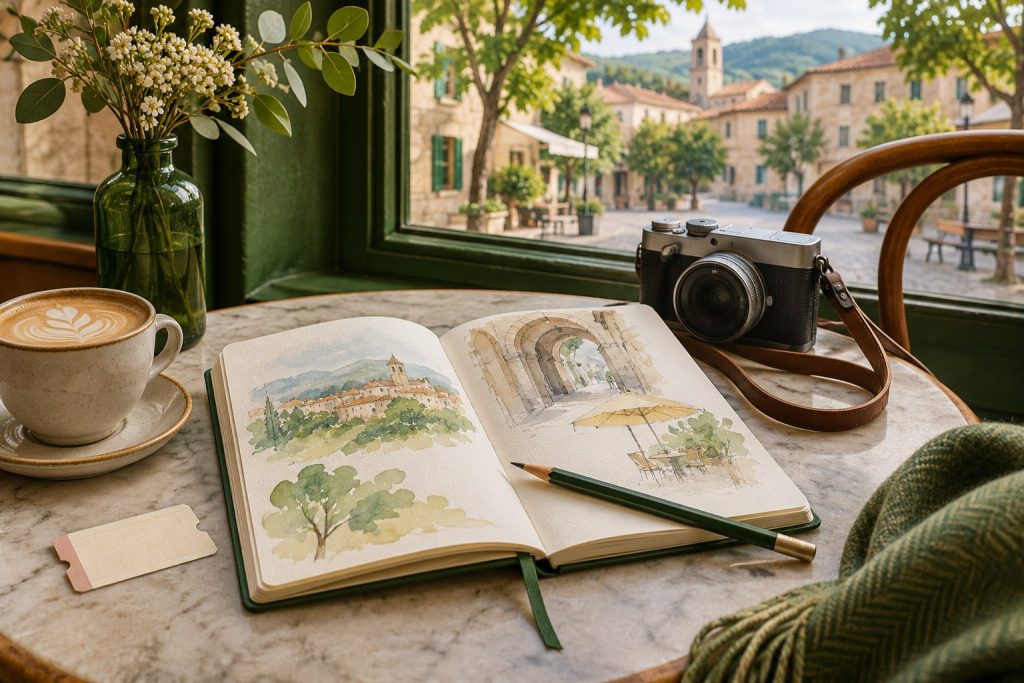
A travel journal does not have to document every hour of a trip. Its most interesting pages may hold a particular conversation, a sketch of a doorway or a note about the meal you kept thinking about afterwards. These details can make a visit easier to remember than a complete list of attractions. The challenge is finding a way to record them that fits around travelling itself. A small notebook, a simple document or brief voice notes can all work. Choose a format that invites a few observations without asking you to become your trip's full-time archivist.
Choose a format you will actually carry
The best journal is available when you want to use it. A pocket notebook suits quick sketches and handwritten fragments. A digital document can be easier to search and may suit someone who already writes comfortably on a phone. Audio notes can capture a thought when sitting down to type is inconvenient, provided recording is appropriate to the setting. You can combine formats, but keep the arrangement simple. If every note requires choosing between several applications, the system may compete with the experience you are trying to remember in the first place.
Record a few useful anchors
Add the date and the place, including a neighbourhood or venue name when it matters. Those details may feel obvious during the trip and become surprisingly difficult to reconstruct later. You do not need a detailed timetable. A few anchors help connect a memory to a photograph, a map or another day's entry. When recording a name you have heard, check the spelling if you can do so politely. Distinguish confirmed details from your own impressions. A journal can be personal and informal while still leaving you enough context to understand what happened when you revisit it.
Notice what a photograph may miss
Write about sounds, textures, smells, weather and the pace of a place. Perhaps a station announcement interrupted a conversation, a market stallholder explained an unfamiliar ingredient or rain changed the colour of the pavement. Choose the details that caught your attention rather than forcing yourself to cover every sense. Ordinary moments often become valuable because they belong to that particular day. A short description can also explain why you took a photograph. The picture may show a doorway, while the note preserves the reason you stood in front of it for several minutes.
Use small prompts when the page feels blank
Try a question with a manageable answer: What surprised me today? What did I misunderstand? What would I like to learn more about? You might record one good conversation, one practical lesson and one detail you would otherwise forget. Prompts are starting points rather than a form you must complete. Some days will deserve a page; others may need only a few words. If you miss a day, begin with the present instead of creating a growing backlog. You can fill a gap later when a memory returns, clearly noting that the entry was written afterwards.
Keep practical notes separate from impressions
An address, a route or an opening time can be useful, but practical information may change. Mark it with the date of your visit and verify it again before using it for another trip or recommending it publicly. Keep booking references and other sensitive information somewhere appropriate rather than in a notebook you plan to share. Your impressions belong to a different category: a quiet square, a generous welcome or a place that felt more hurried than expected. Recording both can be valuable as long as a personal response is not presented as an objective description of everyone's experience.
Be considerate when other people appear
Travel memories often include people you meet briefly. Avoid recording unnecessary private details, and ask permission where photography or recording requires it. A private journal and a public blog have different audiences. Before sharing an entry, consider whether a name, image or conversation could identify someone who did not expect publication. You can preserve what you learned without reproducing every personal detail. Be equally thoughtful about cultural observations. Describe the specific situation you encountered instead of turning one interaction into a claim about an entire city, community or country.
Revisit the journal before polishing it
After the trip, give the notes a quick pass while the context is still familiar. Add missing place names, match a few photographs and clarify fragments that would be puzzling later. Make an appropriate copy of digital material, or photograph handwritten pages you would be sorry to lose. Resist the pressure to transform everything into a beautiful finished album immediately. A travel journal can remain uneven and still be rewarding to revisit. Its value lies in the observations you preserved: the small, particular pieces of a journey that a standard itinerary could never have recorded for you.
Related reading: How to Plan a Relaxed City Break Without Overfilling Every Day.